
Imagine you had some blood reports done. They were requested by your doctor, just a standard procedure. You get the report back and glance at it—you see one value marked in red.
Your heart starts beating faster. Suddenly your breath changes, your eyes widen. You look at it more closely and instantly turn on your phone, open ChatGPT, give it your report and ask it to explain.
The model gives you possible outcomes of what that higher value might be related to.
You pick the first one.
You ask for its symptoms.
Within seconds, you get a list: headache, stomach ache, loss of appetite, and more.
You pause.
These symptoms… you’ve felt them before.
Suddenly, everything clicks.
Your blood starts pumping faster. You might have this disease. You search it on Google and find horrifying images of patients dealing with it. You imagine this becoming your life—with a mask over your mouth, needles attached to your body, your loved ones standing around you with sadness and empathy.
You’ve already accepted it.
You tell yourself you’ll handle it and try to carry on with your day. But something feels off. That thought stays with you, creating a deep, heavy space inside.
Nothing feels the same anymore.
Colors fade. The golden hue of the morning, the calming green of trees, even the dull grey of concrete—everything feels lifeless. You force yourself through the day, waiting for tomorrow so you can finally see the doctor and begin treatment.
But sleep doesn’t come easily.
Your mind is racing. Thoughts collide, theories form, possibilities expand. Your brain is working at full speed, consuming energy. Your body responds—fatigue, heaviness, a slow metabolism, trying to conserve energy. But for you, it just feels worse.
The next day, on your way to the clinic, you notice people around you—a man heading to work, a fruit vendor on the roadside, a beggar in worn-out clothes asking for money.
But that’s not what you really see.
You see them as lucky.
They don’t have this disease.
You feel smaller than them. Inferior. As if something has already been taken away from you.
You enter the clinic, still carrying those thoughts.
Your turn comes. You walk into the doctor’s room. He greets you calmly. You respond, but you’re speaking fast now. He notices—you’re anxious.
You hand him the report.
He looks at it.
Calm.
Unbothered.
Why is he not reacting?
You start questioning—are doctors this heartless, or have they just seen so much that they stopped caring?
Your patience runs out.
You ask him directly.
He says, “Everything is okay. I just wanted to check your red blood cells—to see how your immune system is working. It’s fine.”
You feel frustrated.
“That’s not the point. What about this value? The one in red?”
You point at it.
He looks again and says, “Oh, this? This is nothing. It doesn’t mean your kidney is failing. This is slightly high because of the medicine you’re taking for your cough.”
And just like that—
Everything collapses.
All the fear. All the thoughts. All the energy you spent worrying.
For something that wasn’t even real.
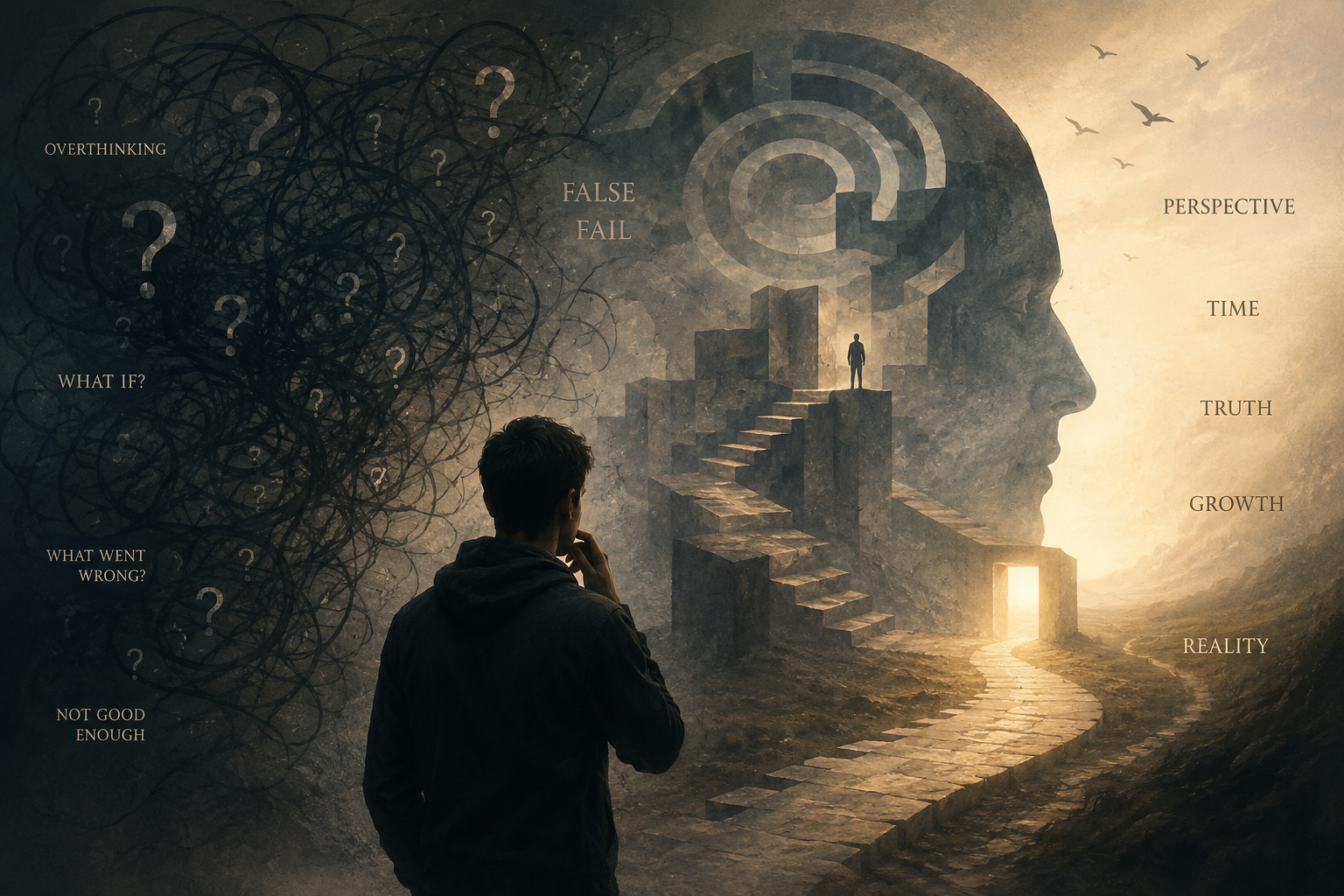
This is what we can call a false failure.
In life, we rely heavily on signals—metrics, results, feedback—to measure progress. If we don’t see improvement, we assume failure.
If your physique doesn’t change, what’s the point of going to the gym? If your energy levels stay the same, why keep trying? If your results don’t show up, why continue putting in effort?
These signals matter. They drive us.
But sometimes, we misread them.
We take a temporary, specific setback and turn it into a permanent, general conclusion.
History is full of people and systems that refused to do that.
Japan continued rebuilding after nuclear devastation. China kept growing even when it was a small fraction of the US economy. Individuals like Jack Ma faced dozens of job rejections but didn’t accept them as proof of inability. Steve Jobs was removed from his own company, yet returned and reshaped an entire industry.
They didn’t ignore failure.
They just didn’t mislabel it.
A false failure is when you interpret a signal incorrectly.
When you assume:
- This defines me
- This is permanent
- This is the end
When in reality, it might just be:
- Temporary
- Contextual
- Fixable
- Or completely misunderstood
The difference comes down to how you interpret the moment.
Before accepting failure, ask:
- Will this matter in 2–3 years?
- Does this define my ability or just this situation?
- Am I reacting emotionally or observing objectively?
- Is this truly the end, or just one version of it?
Not every red mark means something is wrong.
Sometimes, it just means you’re looking at it the wrong way.